
[Leia a versão em português abaixo]
Welcome to ‘Transformative Tales: Voices of Empowerment’. In this interview series, you’ll meet inspiring women who fight against inequality, social injustice and climate change. My aim is to amplify their voices and stories, so more people can see the change they are driving. And by women, I mean everyone who identifies as a woman. Their experiences and insights are a source of inspiration for us all.
Let’s make a difference together, one story at a time! 🌟
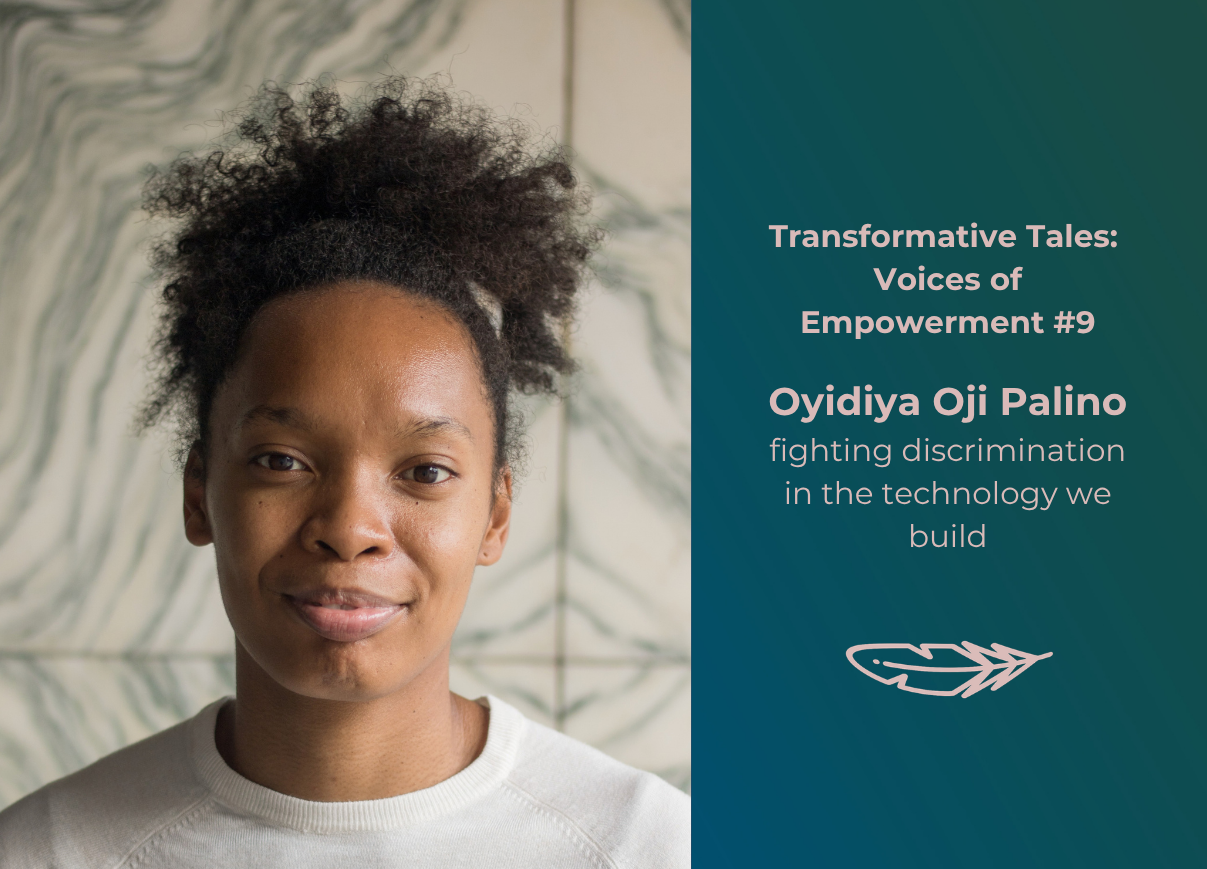
Oyidiya Oji Palino: fighting discrimination in the technology we build
“Discrimination doesn’t just happen in face to face interactions at the workplace, in healthcare or with the police”, says Oyidiya Oji Palino. “It’s also embedded in the systems running behind them.” As digital rights policy officer at the European Network Against Racism (ENAR)*, she looks into how digital systems entrench existing inequality
The European debate on technology tends to circle around innovation, competitiveness and the race with the United States and China. Oyidiya looks beyond that economic logic. “Is anyone thinking about fundamental rights? About non-discrimination? Are we building this technology so companies can turn a profit, or so society actually benefits?”
Shut out from the start
The question of who feels welcome in the world of technology touches on her own history. “When I was little, I thought technology wasn’t for me,” says Oyidiya, who grew up in Spain. With two brothers and only two controllers between three children, she was usually the one left out of gaming. “And that’s how it started: from video games to our PC and then the laptop. I kept getting shut out, and at some point I just told myself: I don’t like this.”
School didn’t encourage her to explore that technical side either. When it came time to choosing subjects, plenty of girls, herself included, went for French. Boys were more likely to pick the sciences. That gave them an earlier shot at discovering that world. “It’s interesting how early that starts,” says Oyidiya. “Boys get pushed in one direction, girls in another.”
From finance to data science
Oyidiya eventually studied International Business and spent years working in finance and logistics. During the pandemic, she started questioning whether she wanted to carry on down that path. “I wanted to do something that fit my values better. Something where I could actually make a difference.”
She decided to immerse herself in technology after all. “Data science appealed to me because you’re looking for patterns, forming hypotheses and testing whether they hold up.” But the more she learned about data, the more she understood it’s never just about numbers. It’s also about power, both who holds the data and whose experience shapes it. “When certain people have access to certain information, it gives them an enormous head start.”
When the system doesn’t recognise you
That realisation crystallised in 2021, when she read about problems with self-driving Teslas in the United States. “They struggled to recognise women and people with disabilities”, she says. “They were essentially just driving into them.” Around the same time, she noticed similar patterns in voice software. Certain English accents, such as Irish accents and Vernacular English typically spoken by African Americans , were recognised less accurately.
According to Oyidiya, that’s not purely a technological problem, it’s cultural insensitivity. “It shows who built those systems, who collected the data, and who thought: if it works for us, it’ll work for everyone”, she explains. “New systems get built on existing structures, on the ideas, choices and inequalities that already exist in society. If that foundation is already unequal, technology just adds another layer of inequality on top. The original problem doesn’t go away.”
An overwhelmingly white space
That’s why Oyidiya believes it’s important for more diverse perspectives to become part of the conversation about technology. Relatively many women work in digital rights, but other voices are often still missing. “There are very few racialised people and other lived experiences are barely represented either”, she says. “It’s still an overwhelmingly white space.”
At the same time, she notices that a lot of people think they can’t take part in conversations about technology because they don’t have a technical background. “But it’s not just about technical knowledge,” she says. “People bring their own experiences too. That’s valuable in itself.”
Turning insight into action
Oyidiya tries to put that conviction into practice in her work at ENAR. She helps organisations that have less easy access to European decision-making get their voices heard there. She also works alongside other networks and organisations working on digital rights challenging the use of digital tools in areas such as migration and policing.
Even so, Oyidiya is well aware of the scale of the forces she’s up against. Sometimes she wonders how much difference her work can really make, especially when she sees far-right parties gaining influence around the world. “It’s disheartening to watch racist, sexist and ableist rhetoric become more and more normalised, without any consequences. And to see the people spreading chaos and disinformation never being held accountable.”
Strenght in numbers
Still, she doesn’t let it stop her. “I feel privileged to be able to do this work”, she says. “In fact, I’d do it even if I weren’t paid for it.” She sees it as part of a collective responsibility: change doesn’t come from one person alone. “Think of an ant,” she says. “One ant on its own doesn’t amount to much. But together, they are incredibly strong. Their strength lies in working together.”
Footnote: European Network Against Racism: a pan-European network working on advocacy to put an end to structural racism and discrimination across Europe and build structures based on equality and redistribution of power, privileges and rights.
——————————————————————————————————————————————————————————————————
[versão em português]
Bem-vindo(a) a Transformative Tales: Voices of Empowerment. Nesta série de entrevistas, você vai conhecer mulheres inspiradoras que lutam contra a desigualdade, a injustiça social e a crise climática. Meu objetivo é amplificar suas vozes e histórias, para que mais pessoas possam enxergar as mudanças que elas estão impulsionando. E quando falo em mulheres, quero dizer todas as pessoas que se identificam como mulheres. Suas experiências e percepções são fonte de inspiração para todas nós.
Vamos fazer a diferença, uma história de cada vez! 🌟
Oyidiya Oji Palino: combatendo a discriminação na tecnologia que construímos
“A discriminação não acontece só nas interações cara a cara no trabalho, nos serviços de saúde ou com a polícia”, diz Oyidiya Oji Palino. “Ela também está embutida nos sistemas que funcionam por trás delas.” Como assessora de políticas de direitos digitais da Rede Europeia Contra o Racismo (ENAR, na sigla em inglês)*, ela investiga como os sistemas digitais consolidam desigualdades que já existem.
O debate europeu sobre tecnologia costuma girar em torno de inovação, competitividade e da corrida com os Estados Unidos e a China. Oyidiya olha além dessa lógica econômica. “Alguém está pensando nos direitos fundamentais? Na não discriminação? Estamos construindo essa tecnologia para que as empresas lucrem ou para que a sociedade realmente se beneficie?”
Excluída desde o início
A questão de quem se sente bem-vindo no mundo da tecnologia toca na sua própria história. “Quando eu era pequena, achava que a tecnologia não era para mim”, conta Oyidiya, que cresceu na Espanha. Com dois irmãos e só dois controles para três crianças, geralmente era ela quem ficava de fora dos videogames. “E foi assim que começou: dos videogames para o nosso PC e depois para o notebook. Eu sempre ficava de fora, e em algum momento simplesmente pensei: eu não gosto disso.”
A escola também não a incentivou a explorar esse lado técnico. Na hora de escolher as matérias, muitas meninas, incluindo ela, optaram por francês. Os meninos tendiam mais a escolher as ciências. Isso lhes deu a chance de descobrir esse mundo mais cedo. “É interessante como isso começa cedo”, diz Oyidiya. “Os meninos são empurrados para um lado, as meninas para outro.”
Das finanças à ciência de dados
Oyidiya acabou estudando Negócios Internacionais e passou anos trabalhando com finanças e logística. Durante a pandemia, começou a se perguntar se queria continuar nesse caminho. “Eu queria fazer algo mais alinhado com os meus valores. Algo com que eu realmente pudesse fazer a diferença.”
Ela decidiu, afinal, mergulhar na tecnologia. “A ciência de dados me atraía porque você procura padrões, formula hipóteses e testa se elas se sustentam.” Mas quanto mais aprendia sobre dados, mais entendia que eles nunca se resumem a números. Eles também têm a ver com poder: quem detém os dados e de quem é a experiência que dá forma a eles. “Quando certas pessoas têm acesso a certas informações, isso lhes dá uma enorme vantagem.”
Quando o sistema não reconhece você
Essa percepção se consolidou em 2021, quando ela leu sobre problemas com carros autônomos da Tesla nos Estados Unidos. “Eles tinham dificuldade para reconhecer mulheres e pessoas com deficiência”, conta. “Na prática, simplesmente batiam nelas.” Mais ou menos na mesma época, ela notou padrões parecidos em softwares de voz. Certos sotaques do inglês, como os irlandeses e o inglês vernacular falado tipicamente por afro-americanos, eram reconhecidos com menos precisão.
Segundo Oyidiya, isso não é um problema puramente tecnológico. É falta de sensibilidade cultural. “Mostra quem construiu esses sistemas, quem coletou os dados e quem pensou: se funciona para nós, vai funcionar para todo mundo”, explica ela. “Novos sistemas são construídos sobre estruturas existentes, sobre as ideias, escolhas e desigualdades que já existem na sociedade. Se essa base já é desigual, a tecnologia só acrescenta mais uma camada de desigualdade por cima. O problema original não desaparece.”
Um espaço esmagadoramente branco
Por isso, Oyidiya acredita que é importante que perspectivas mais diversas passem a fazer parte da conversa sobre tecnologia. Há relativamente muitas mulheres trabalhando com direitos digitais, mas outras vozes ainda costumam faltar. “Há pouquíssimas pessoas racializadas, e outras vivências também quase não estão representadas”, diz ela. “Ainda é um espaço esmagadoramente branco.”
Ao mesmo tempo, ela percebe que muita gente acha que não pode participar das conversas sobre tecnologia por não ter formação técnica. “Mas não se trata só de conhecimento técnico”, diz. “As pessoas também trazem suas próprias experiências. Isso já tem valor por si só.”
Da percepção à ação
Oyidiya procura pôr essa convicção em prática no seu trabalho na ENAR. Ela ajuda organizações com menos acesso à tomada de decisões europeia a fazer suas vozes serem ouvidas. Também atua ao lado de outras redes e organizações de direitos digitais que questionam o uso de ferramentas digitais em áreas como migração e policiamento.
Ainda assim, Oyidiya tem plena consciência do tamanho das forças que enfrenta. Às vezes ela se pergunta que diferença seu trabalho pode realmente fazer, principalmente quando vê partidos de extrema direita ganhando influência pelo mundo. “É desanimador ver a retórica racista, sexista e capacitista se tornar cada vez mais normalizada, sem nenhuma consequência. E ver que as pessoas que espalham caos e desinformação nunca são responsabilizadas.”
A união faz a força
Mesmo assim, ela não se deixa abater. “Eu me sinto privilegiada por poder fazer esse trabalho”, diz. “Na verdade, eu faria isso mesmo se não fosse paga.” Ela vê o trabalho como parte de uma responsabilidade coletiva: a mudança não vem de uma pessoa sozinha. “Pense numa formiga”, diz ela. “Uma formiga sozinha não faz muita coisa. Mas juntas, são incrivelmente fortes. A força delas está em trabalhar juntas.”
*Nota: Rede Europeia Contra o Racismo (ENAR): rede pan-europeia que faz incidência política (advocacy) para acabar com o racismo estrutural e a discriminação na Europa e construir estruturas baseadas na igualdade e na redistribuição de poder, privilégios e direitos.
