
[Leia a versão em português abaixo]
Welcome to ‘Transformative Tales: Voices of Empowerment’. In this interview series, you’ll meet inspiring women who fight against inequality, social injustice and climate change. My aim is to amplify their voices and stories, so more people can see the change they are driving. And by women, I mean everyone who identifies as a woman. Their experiences and insights are a source of inspiration for us all.
Let’s make a difference together, one story at a time! 🌟
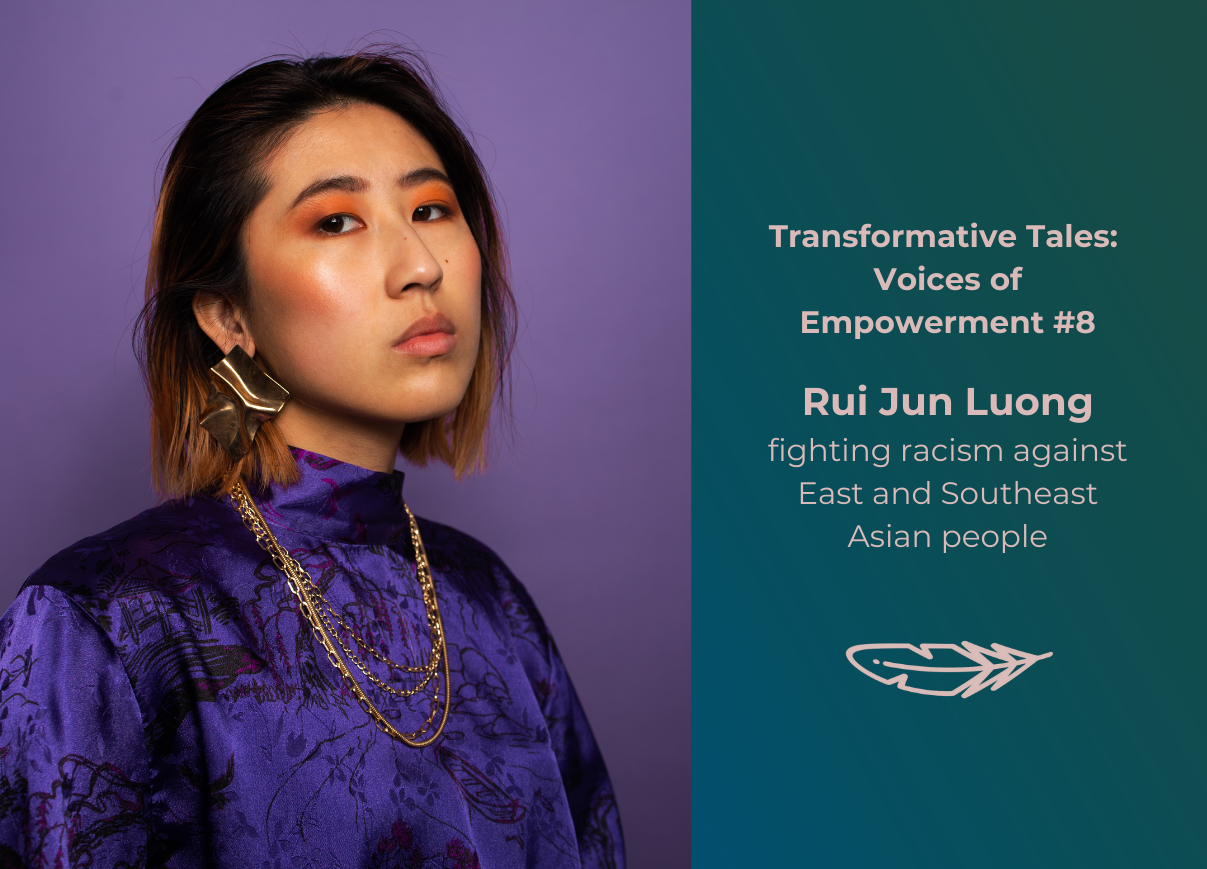
Rui Jun Luong: fighting racism against East and Southeast Asian people
For Rui Jun Luong, it didn’t begin with big words, but with comments that were often dismissed as harmless. With ‘jokes’ that didn’t feel funny to her at all. It was only later that she learned to identify those experiences as racism. She grows up in the north of the Netherlands, in a predominantly white environment. As a Chinese girl, she finds little recognition there, and no role models. She feels ashamed of her background, culture and identity.
For a long time, she believes the comments will stop when she gets older. “But I was optimistic – the reality turned out differently,” she says. “It kept happening. Over and over again, with people telling me it ‘wasn’t meant that way’ or that I ‘shouldn’t take it so seriously’.”
She feels that something is not right, but for a long time she can’t find the words for it. During her studies at art academy, she starts looking for context. She delves into her background, especially the history of her father, who fled from South Vietnam to the Netherlands.
“That’s when I started recognising patterns of ignoring and pushing things aside,” she explains. “Experiencing things, but not talking about them.” She sees those patterns reflected in herself as well. “The idea was always: look ahead, forget the negative.” Slowly, she realises that silence is also a form of passing things on. That what she experiences doesn’t stand alone, but fits into broader patterns in society. “That’s when I thought: I have to do something with this.”
From experience to voice
From that moment on, Rui Jun decides to speak out. As a designer, artist and photographer, she uses her work and social media to highlight the racism and stereotyping she encounters in everyday life. She also participates in public debates and appears in the media. Not from an abstract position, but from what she herself sees and experiences.
She focuses increasingly explicitly on racism against East and Southeast Asian people, such as Chinese, Vietnamese or Thai people. In society and in the media, she often sees these groups portrayed in stereotypical images: flat, one-dimensional, reduced to caricatures. According to Rui Jun, these images are not separate from racism; they actively feed prejudice and exclusion.
This becomes painfully clear in 2020, when East and Southeast Asian people around the world are targeted, insulted and held responsible for the virus during the COVID-19 pandemic. What had long been downplayed or normalised suddenly becomes widely and unmistakably visible.
Asian Raisins: racism as a pattern
In the same year, Rui Jun founds Asian Raisins, a foundation dedicated to fighting racism against East and Southeast Asian people. “Everything I do within Asian Raisins is aimed at raising awareness,” she explains. “Because there’s still very little knowledge about this subject.” Within the foundation, racism is made visible not as isolated incidents, but as recurring patterns. Together with a group of volunteers, Rui Jun organises discussions and campaigns, builds online communities and creates spaces where people with shared experiences can find one another. The foundation also manages a reporting centre for racism and discrimination.
Representation as a graduation project
These experiences shape her work as an artist too. For her graduation project at the art academy, Rui Jun creates a project centred on representation: how Asian people are seen and understood. She first has to convince her teachers that her work addresses racism and prejudice – and that this reality affects her personally. “These were the same teachers who had to assess my work and decide whether or not I could graduate,” she says. Nevertheless, Rui Jun persevered with her project.
She graduates with ‘Guess Who: Asian Edition’, a life-sized version of the classic guessing game, featuring only Asian faces. In colourful portraits, Rui Jun shows the diversity of the Asian continent. It’s precisely this broad approach that reveals how narrow and one-sided the term ‘Asian’ is often used. “The game is a huge statement,” she says. “For me, it’s my most important contribution: making visible what is often ignored or flattened. I’m proud of it.”
Speaking out comes at a cost
The success of the game – in 2022, she wins the Dutch Creativity Award – increases her public visibility, which also makes her position more vulnerable. Those who speak out against racism do not only receive support, but also resistance. Every day, her social media posts attract comments that downplay or deny her experiences, alongside openly hateful remarks. “That makes this work much harder than people realise,” she says.
Setting boundaries, staying engaged
In 2026, Rui Jun therefore decides to take a break from her activist work. Not because the issue is any less urgent. “Racism won’t stop by itself,” she says. But because this constant form of speaking out and staying engaged demands a lot: time, energy and health. Protecting her boundaries is necessary.
“A lot of people say, ‘It’s great that you speak out about this,’” she explains. “But I always think: you can do that too. I’m just one person.” According to Rui Jun, change happens when more people make their voices heard. “By pointing out something that others may not yet see, you plant a seed. And that’s exactly what it’s all about. Sometimes the insight only grows later.”
——————————————————————————————————————————————————————————————————
[versão em português]
Bem-vindo(a) a Transformative Tales: Voices of Empowerment. Nesta série de entrevistas, você vai conhecer mulheres inspiradoras que lutam contra a desigualdade, a injustiça social e a crise climática. Meu objetivo é amplificar suas vozes e histórias, para que mais pessoas possam enxergar as mudanças que elas estão impulsionando. E quando falo em mulheres, quero dizer todas as pessoas que se identificam como mulheres. Suas experiências e percepções são fonte de inspiração para todas nós.
Vamos fazer a diferença, uma história de cada vez! 🌟
Rui Jun Luong: enfrentando o racismo contra pessoas do Leste e Sudeste Asiático
Para Rui Jun Luong, não começou com grandes palavras, mas com comentários que muitas vezes eram tratados como inofensivos. ‘Piadas’ que para ela não tinham graça nenhuma. Só mais tarde ela passou a identificar essas experiências como racismo. Ela cresce no norte dos Países Baixos, em um ambiente predominantemente branco. Como menina chinesa, encontra pouca identificação e nenhuma referência com as quais se identifica. Sente vergonha de sua origem, cultura e identidade.
Durante muito tempo, ela acredita que esses comentários vão desaparecer naturalmente, à medida que ela envelhece. “Mas eu era otimista – a realidade foi outra,” conta ela. “Isso continuou acontecendo. Sempre acompanhada das mesmas frases: que ‘não era essa a intenção’ e que eu ‘não deveria levar tão a sério’.”
Ela sente que algo está errado, mas por muito tempo não consegue colocar isso em palavras. Durante seus estudos na academia de artes, começa a buscar contexto. Aprofunda-se em sua história familiar, principalmente na trajetória de seu pai, que fugiu do Vietnã do Sul para os Países Baixos.
“Foi então que comecei a reconhecer padrões de negção e silenciamento,” conta ela. “Viver situações difíceis, mas não falar sobre elas.” Ela percebe esses padrões também em si mesma. “A ideia era sempre: seguir em frente, esquecer o era negativo.” Aos poucos, ela entende que o silêncio também é uma forma de transmissão. O que vive não é algo isolado, mas parte de padrões mais amplos da sociedade. “Foi aí que pensei: preciso fazer algo com isso.”
De vivência a voz
A partir desse momento, Rui Jun decide se posicionar. Como designer, artista e fotógrafa, ela passa a usar seu trabalho e as redes sociais para nomear o racismo e os estereótipos que encontra no dia a dia. Também participa de debates públicos e aparece na mídia. Não a partir de conceitos abstratas, mas daquilo que ela mesma vive e observa.
Com o tempo, seu foco se torna cada vez mais claro: o racismo contra pessoas do Leste e Sudeste Asiático, como chinesas, vietnamitas ou tailandesas. Na sociedade e na mídia, ela vê esses grupos frequentemente retratados de forma estereotipada: superficiais, unilaterais, reduzidas a caricaturas. Para Rui Jun, essas imagens não estão separadas do racismo; elas alimentam preconceitos e exclusão.
Em 2020, isso se torna dolorosamente evidente. Durante a pandemia de COVID-19, pessoas do Leste e Sudeste Asiático passam a ser abordadas, insultadas e responsabilizadas pelo vírus em várias partes do mundo. Aquilo que por muito tempo foi minimizado ou normalizado vem à tona de forma aberta e inegável.
Asian Raisins: racismo como padrão
Nesse mesmo ano, Rui Jun funda a Asian Raisins, uma organização dedicada a enfrentar o racismo contra pessoas do Leste e Sudeste Asiático. “Tudo o que fazemos na Asian Raisins é voltado para a conscientização,” explica ela. “Porque ainda há muito pouco conhecimento sobre esse tema.”
Na organização, o racismo é mostrado não como incidentes isolados, mas como padrões recorrentes. Junto com um grupo de voluntários, Rui Jun organiza debates e campanhas, constrói comunidades online e cria espaços onde pessoas com experiências semelhantes podem se encontrar. A organização também mantém um canal de denúncias sobre racismo e discriminação.
Imagem como projeto de gradução
Essas vivências também influenciam seu trabalho como artista. Em seu projeto de formatura na academia de artes, Rui Jun escolhe trabalhar a questão da imagem: como pessoas asiáticas são vistas e compreendidas. Ela logo percebe que esse não é um tema considerado óbvio. Precisa convencer seus professores de que seu trabalho trata de racismo e preconceito – e de que essa realidade também a afeta pessoalmente. “Eram os mesmos professores que teriam que avaliar meu trabalho e decidir se eu poderia ou não me formar,” conta ela. Mesmo assim, Rui Jun segue adiante com o projeto.
Ela se forma com ‘Guess Who: Asian Edition’, uma versão em tamanho real do jogo Quem é Quem?, composta exclusivamente por retratos de pessoas asiáticos. Em imagens coloridos, Rui Jun mostra a diversidade do continente asiático. É justamente essa abordagem ampla que torna visível o quanto o termo ‘asiático’ costuma ser usado de forma limitada e reducionista. “Esse jogo é uma grande afirmação,” diz. “Para mim, é a minha contribuição mais importante: tornar visível aquilo que tantas vezes é ignorado ou menosprezado. Tenho muito orgulho disso.”
Manifestar-se tem um custo
O sucesso do jogo – que lhe rende o Dutch Creativity Award em 2022 – amplia sua visibilidade pública, mas também torna sua posição mais vulnerável. Quem se manifesta contra o racismo não recebe apenas apoio, mas também resistência. Diariamente, aparecem comentários em suas postagens nas redes sociais que minimizam ou negam suas experiências, além de mensagens abertamente hostis. “Isso torna esse trabalho muito mais pesado do que as pessoas imaginam,” diz ela.
Estabelecer limites, seguir envolvida
Por isso, em 2026, Rui Jun decide fazer uma pausa em seu trabalho ativista. Não porque o tema tenha se tornado menos urgente. “O racismo não vai acabar por si,” diz ela. Mas porque essa forma constante de se posicionar e se expor exige muito: tempo, energia e saúde. É necessário proteger seus limites.
“Muitas pessoas dizem: ‘Que bom que você se manifesta sobre isso’,” conta ela. “Mas eu penso: você também pode fazer isso. Eu sou só uma pessoa.” Para Rui Jun, a mudança acontece quando mais pessoas decidem se manifestar. “Ao nomear algo que outras ainda não enxergam, você planta uma semente. E é exatamente disso que se trata. Às vezes, a compreensão só vem depois.”
